Power With Neighbors, Not Just From Them: How Community Microgrids Are Rewriting the Rules of Resilience
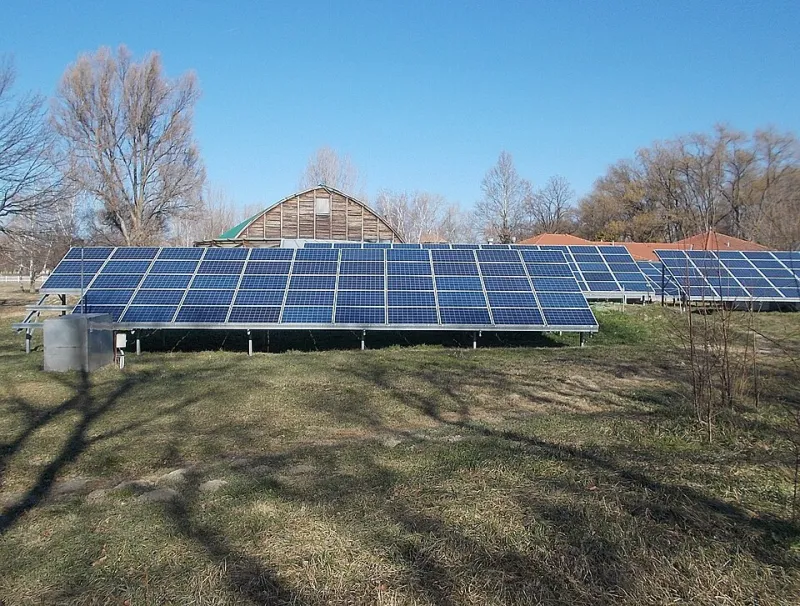
Photo: Globetrotter19, CC BY-SA 3.0, via Wikimedia Commons
When a severe storm knocked out power across parts of California in 2022, one apartment complex in Oakland barely noticed. Its lights stayed on, its refrigerators hummed, and its community room doubled as a charging station for neighbors down the block. The reason was not luck. It was a shared microgrid: a small, self-contained network of solar panels, batteries, and intelligent switches that can disconnect from the central grid and keep running on its own.
Once a niche technology reserved for hospitals and military bases, the community microgrid is moving into American residential life — and it may reshape how we think about who owns and controls the power we depend on.
What Exactly Is a Community Microgrid?
At its core, a microgrid is simply a bounded electrical system with three ingredients: local generation (usually rooftop or canopy solar), energy storage (typically battery banks), and a control system that decides when to draw from the utility, when to store, and when to island itself from the grid entirely.
What makes a community microgrid different is scope. Rather than a single homeowner installing panels and a battery for personal backup, a microgrid links multiple buildings — a cul-de-sac, a condominium complex, a mobile home park, or an entire small town — into one coordinated system. Shared infrastructure means shared costs, and shared costs mean households that could never afford a standalone battery system can still benefit.
Projects Leading the Way
Several real-world examples illustrate the range of what is possible:
- Stoneedge Garden Apartments, Santa Barbara, California. A federally assisted housing complex installed roughly 700 kilowatts of solar and over a megawatt-hour of storage, allowing the property to sustain its common areas and select apartments during outages — a meaningful safeguard for residents with medical equipment needs.
- The Bronzeville Community Microgrid, Chicago. Commonwealth Edison's demonstration project on the city's South Side connected public facilities, including fire and police stations, into a network capable of islanding during emergencies, proving the model works in dense urban environments.
- Borrego Springs, California. A desert town of roughly 3,000 residents operates a utility-owned microgrid that has kept the community powered through heat waves and transmission failures, since its single feeder line to the outside grid is vulnerable to desert storms.
The Hurdles Nobody Puts in the Brochure
The technology is arguably the easy part. The hard obstacles are legal and financial.
Regulatory boundaries. In most states, only regulated utilities are permitted to sell electricity across public rights-of-way. A neighborhood microgrid that wants to share power between homes — not just within one metered building — may need to navigate utility commission rules or secure exemptions. States including California, New York, and Connecticut have begun creating pathways, but the patchwork is inconsistent.
Upfront capital. Solar-plus-storage at neighborhood scale routinely runs into seven figures. Federal incentives — most notably the Investment Tax Credit and, where applicable, Department of Energy grant programs — can offset a substantial share, but assembling financing across dozens of households requires legal structures such as cooperatives, special districts, or homeowner association vehicles.
Utility cooperation. Interconnection agreements, safety standards, and tariff rules all require coordination with the incumbent utility. Some utilities embrace microgrids as resilience assets; others treat them as competitive threats.
A Roadmap for Your Street
If your neighborhood is considering a shared energy system, the sequence generally looks like this:
- Build a coalition. Successful projects start with a handful of engaged neighbors, not a consultant. Identify interested households and a shared priority — outage resilience, bill savings, or backup for medical needs.
- Commission a feasibility study. State energy offices and some utilities offer assessments that model load requirements, solar potential, and storage sizing.
- Engage your utility commission. Determine whether your state permits energy sharing across meters and what interconnection rules apply.
- Structure ownership and financing. Weigh a cooperative model, third-party ownership, or utility partnership against local legal requirements.
- Phase the build. Many communities start with critical loads — a clubhouse, well pump, or shared refrigerator bank — then expand as funding allows.
A More Resilient Grid, One Block at a Time
The American grid was engineered around a one-way flow of electricity from large plants to passive consumers. Community microgrids invert that logic, turning neighborhoods into active participants in their own reliability. The hurdles are real, but so is the momentum. For communities tired of watching storm outages stretch from hours into days, the tools to take a measure of control are finally within reach — and increasingly, the neighbors are the ones holding them.