When Everyone Plugs In at Once: How Neighborhood EV Charging Is Quietly Straining the Wires Beneath Your Street
A Quiet Revolution With Loud Consequences
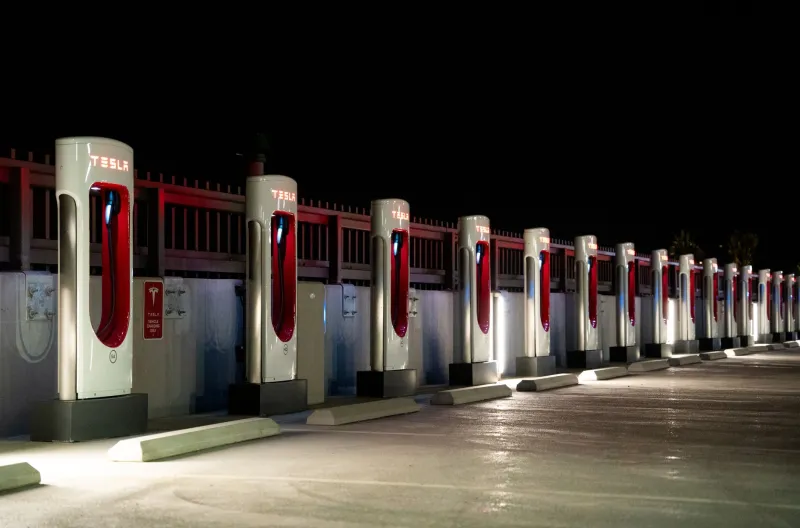
Drive through almost any established suburban neighborhood in the United States today and you will notice something that was nearly invisible five years ago: the steady glow of charging indicators in garage windows, extension cords snaking from outlets, and Level 2 charging stations mounted beside front doors. Electric vehicle ownership has moved from novelty to mainstream with remarkable speed, and for most individual households, the transition has been seamless.
For the distribution infrastructure buried beneath those streets, however, the story is considerably more complicated.
The wires, transformers, and switching equipment that deliver electricity to residential neighborhoods were engineered decades ago against a very different set of assumptions. Engineers designed those systems to handle peak loads driven primarily by air conditioning, electric ranges, and water heaters — appliances whose collective behavior across a neighborhood was reasonably predictable. A single Level 2 home EV charger can draw between 7 and 11 kilowatts continuously for several hours. Multiply that by ten, fifteen, or twenty households on the same distribution transformer, all returning home within the same two-hour window after a workday, and the arithmetic becomes uncomfortable very quickly.
The Transformer at the Center of the Problem
Most homeowners have never given a second thought to the cylindrical gray canisters mounted on utility poles or the squat green boxes tucked into landscaping along their streets. These distribution transformers are, in practical terms, the last significant piece of electrical infrastructure before power enters a home. A single transformer typically serves somewhere between five and fifty homes, depending on the age of the neighborhood and the density of development.
Utility engineers design transformers with a load capacity that reflects expected peak demand — and for most of the past half century, that math worked reliably. What it did not account for was the possibility that a meaningful fraction of the homes on a given transformer's circuit would simultaneously add a high-draw appliance that operates for three to five hours during the same evening window.
When transformer loading exceeds design thresholds, the consequences range from mildly inconvenient to genuinely damaging. Voltage sag — the phenomenon behind flickering lights and underperforming appliances — is often the first symptom residents notice. Sustained overloading accelerates transformer aging, shortening equipment lifespans that utilities had projected in decades. In documented cases across California, Texas, and several mid-Atlantic states, distribution transformers serving streets with high EV adoption rates have failed prematurely, requiring emergency replacement at significant cost.
Why Utilities Are Flying Partially Blind
One of the more underappreciated challenges in managing residential EV load is the fundamental difficulty of predicting where it will appear. Unlike rooftop solar installations, which require permits and utility interconnection agreements that create a paper trail, most home EV charging equipment is installed with no notification to the serving utility whatsoever. A homeowner purchases a vehicle, contracts an electrician to install a dedicated 240-volt circuit, and begins charging — all without any formal communication with the company responsible for delivering that additional electricity.
Utilities attempting to build accurate load forecasting models are therefore working with incomplete information. They can observe aggregate demand spikes on distribution circuits, but attributing those spikes specifically to EV charging — and projecting how the pattern will evolve as adoption rates climb — requires inference and estimation rather than direct measurement.
Some utilities have begun deploying advanced metering infrastructure and distribution monitoring equipment that provides more granular visibility into neighborhood-level load patterns. Others have launched voluntary EV registration programs, offering modest incentives for customers to disclose vehicle ownership and charging equipment specifications. Participation rates in these programs vary considerably, and even robust enrollment leaves meaningful gaps in the data.
Streets That Are Already Feeling the Pressure
The problem is not theoretical. In parts of suburban Southern California, utility crews have replaced transformers on individual residential streets multiple times within a span of just a few years as EV adoption accelerated faster than grid reinforcement could keep pace. In the Pacific Northwest, some neighborhoods served by older infrastructure have experienced voltage irregularities during the evening hours that correlate directly with typical post-commute charging windows.
Engineers at several major investor-owned utilities have described the situation using language that would surprise many ratepayers: the distribution grid, in certain localized areas, is already operating closer to its design margins than the system was ever intended to run. The aggregate national statistics on grid capacity can obscure significant localized stress that manifests in specific ZIP codes, on specific streets, at specific hours.
For residents of these communities, the practical implications extend beyond the inconvenience of a flickering light. Sustained voltage sag can reduce the efficiency and lifespan of sensitive electronics, HVAC equipment, and — ironically — EV chargers themselves. Equipment operating continuously near transformer capacity limits generates excess heat, which accelerates insulation degradation and increases the probability of unplanned outages.
Managed Charging as a Partial Answer
The most widely discussed near-term response to concentrated residential EV load is managed or smart charging — the coordination of individual vehicle charging sessions to distribute demand more evenly across time. Utilities in several states have introduced time-of-use rate structures that create meaningful financial incentives for EV owners to delay charging until late evening or overnight hours, when overall system demand is lower and distribution infrastructure has greater available capacity.
Some automakers and third-party charging platform providers have introduced scheduling features that allow vehicles or charging equipment to automatically defer sessions to off-peak windows. When adopted at scale within a neighborhood, this behavioral shift can meaningfully reduce the coincident peak that stresses local transformers.
The limitation of managed charging as a standalone solution is that it depends on voluntary participation and consistent behavior. Even a minority of households that charge immediately upon arriving home — whether due to range anxiety, unfamiliarity with scheduling features, or simple preference — can recreate localized demand spikes that undermine the benefits achieved by their neighbors' cooperation.
What Homeowners Should Understand About Their Community's Capacity
For households considering an EV purchase or a home charging installation, the condition of neighborhood distribution infrastructure is a legitimate practical consideration — one that most consumer guidance on EV ownership does not address.
Contacting your utility before installing Level 2 charging equipment is advisable not merely as a courtesy but as a means of obtaining useful information. Some utilities can provide general guidance on the load condition of the circuit serving your home, and a small number offer formal pre-installation assessments. Understanding whether your street's transformer is already operating near capacity can inform decisions about charging timing and equipment configuration.
Participating in utility managed-charging programs, time-of-use rate plans, or voluntary EV registration initiatives is another concrete step that contributes to the collective management of a shared infrastructure challenge. These programs are most effective when participation is broad, and early adopters who engage tend to receive more favorable rate terms as programs mature.
A Grid That Must Evolve Alongside the Vehicles It Powers
The fundamental tension at the center of this issue is a timing mismatch. EV adoption is accelerating on a consumer-driven timeline that responds to vehicle prices, fuel costs, and environmental considerations. Distribution infrastructure upgrades advance on a utility-planning timeline that involves regulatory proceedings, capital allocation decisions, and construction logistics measured in years rather than months.
Bridging that gap will require action across multiple fronts simultaneously: accelerated transformer replacement and circuit reinforcement in high-adoption corridors, expanded deployment of grid monitoring technology, broader customer participation in demand management programs, and regulatory frameworks that align utility investment incentives with the infrastructure needs of an electrifying transportation sector.
The vehicles arriving in American driveways represent a genuine and necessary shift in how this country powers its transportation. Ensuring that the wires beneath the streets can carry that shift without strain is work that utilities, regulators, and informed customers must pursue together — before the consequences become more than a flicker.