Lights Out, Chargers On: How Overnight EV Demand Is Blindsiding the Grid

For decades, the hours between 11 p.m. and 6 a.m. represented something close to a reprieve for American utilities. Industrial facilities wound down, commercial buildings emptied, and residential demand dropped to its lowest point of the day. Grid operators used those quiet hours to perform maintenance, rebalance transmission loads, and prepare infrastructure for the following morning's surge. The system, imperfect as it was, had a rhythm.
That rhythm is breaking down.
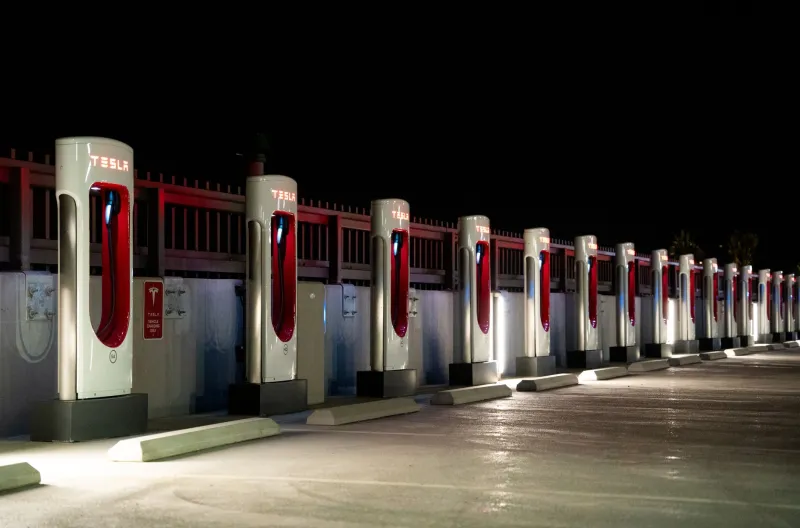
Across the country, a growing fleet of electric vehicles is plugging in after dinner and drawing power through the night—quietly, consistently, and almost entirely outside the visibility of the utilities responsible for keeping the lights on. What was once a manageable trickle of residential charging load has become, in certain neighborhoods and on certain distribution circuits, something closer to an unannounced industrial demand event.
The Scale of What Utilities Cannot See
The core problem is not that EV charging happens at night. Utilities have long anticipated overnight charging as a feature of the EV transition, and many rate structures—including time-of-use pricing—were specifically designed to encourage it. The problem is concentration: when dozens or hundreds of vehicles on the same distribution feeder begin charging simultaneously, the aggregate load can exceed what that feeder was engineered to handle.
Current monitoring infrastructure was not built to track this in real time. Most residential smart meters report consumption data in fifteen-minute or hourly intervals, and that data is often processed with a lag of several hours before it reaches a grid operator's dashboard. By the time an anomaly appears in the system, the stress event may already be over—or the equipment may already be damaged.
Transformer failures on residential streets have historically been rare enough to be treated as isolated maintenance issues. That framing is becoming harder to sustain. Distribution engineers in high-EV-adoption markets including California, Texas, and the Pacific Northwest have begun documenting clusters of transformer failures in neighborhoods with high concentrations of electric vehicles, particularly in older subdivisions where underground equipment was sized for appliance loads that predate the charging era.
Why Scheduling Alone Has Not Solved the Problem
The standard utility recommendation—charge your vehicle during off-peak hours using your charger's built-in scheduling function—sounds straightforward. In practice, it has produced a new version of the original problem.
When a utility defines its off-peak window as, say, midnight to 6 a.m., and communicates that window broadly to customers, a significant share of EV owners programs their chargers to begin at midnight. The result is not a smooth distribution of charging across six hours. It is a demand spike at midnight that can rival a morning peak event, concentrated on circuits that were never designed to absorb it.
This is sometimes called the "rebound peak" phenomenon, and it illustrates a fundamental tension in utility demand management: the tools used to shift load can inadvertently synchronize it. Without granular, real-time visibility into which vehicles are charging on which circuits, utilities have limited ability to stagger that load in a way that protects infrastructure.
The Monitoring Gap and What It Costs
The gap between what utilities know and what is actually happening on residential circuits carries real financial consequences. Transformer replacement is expensive—a single pad-mounted unit can cost between $3,000 and $20,000 installed, and supply chain constraints have extended lead times to a year or more in some regions. When failures occur in clusters, the cost escalates quickly and the repair timeline stretches in ways that leave customers without reliable service.
Beyond direct infrastructure costs, unmonitored charging loads complicate utility planning in ways that ripple outward. Demand forecasts that undercount residential EV load produce capacity procurement decisions that leave insufficient reserves. Interconnection studies for new renewable generation projects rely on accurate baseline load data—data that is increasingly unreliable in high-EV neighborhoods. The inaccuracies compound.
Some utilities have begun deploying advanced distribution management systems capable of integrating real-time data from multiple sources, including grid sensors, smart meters, and—where available—direct communication with managed charging networks. These platforms can identify emerging overload conditions and, in some configurations, send automated signals to enrolled chargers to reduce or pause their draw. The technology exists. The deployment has been slow.
What Homeowners Can Do Right Now
While utilities work through the infrastructure and regulatory processes required to modernize distribution monitoring, individual EV owners have practical options that meaningfully reduce their contribution to localized grid stress.
First, resist the midnight default. If your charger's scheduling function allows you to select a start time, choose a time between 1 a.m. and 4 a.m. rather than midnight. The goal is not simply to charge at night—it is to avoid the synchronized spike that occurs when an entire neighborhood's vehicles start at the same moment.
Second, investigate whether your utility offers a managed charging program. These programs, sometimes called smart charging or vehicle grid integration pilots, allow the utility to send brief load reduction signals to enrolled chargers during stress events. Participants typically receive a bill credit in exchange for this flexibility, and the actual disruption to their charging schedule is minimal—most programs are designed to ensure a full charge is completed before the vehicle is needed.
Third, consider your charger's power level. A Level 2 charger drawing 48 amps places substantially more load on a residential circuit than one drawing 24 amps. For most driving patterns, a mid-range charging rate is sufficient to restore a full charge overnight. Reducing charge rate reduces the per-vehicle contribution to aggregate load.
The Policy Dimension
Addressing the monitoring gap at scale requires regulatory action alongside technological investment. Several states have begun requiring utilities to file distribution system planning documents that explicitly account for projected EV load growth at the feeder level—a meaningful step toward proactive infrastructure management rather than reactive repair.
Federal funding through the Infrastructure Investment and Jobs Act has made capital available for grid modernization projects, including advanced metering infrastructure upgrades that could close portions of the visibility gap. The challenge is translating available funding into deployed equipment on a timeline that keeps pace with EV adoption.
The vehicles are arriving faster than the monitoring systems designed to manage them. Closing that gap—through smarter charging behavior, utility investment in real-time visibility, and regulatory frameworks that treat EV load as the significant grid variable it has become—is among the more consequential infrastructure challenges of the current decade.
At Pipps Energy, we believe that sustainable electrification requires honest accounting of the stresses it places on existing systems. The overnight charging problem is solvable. Solving it requires acknowledging it first.